New pilot: Harvard Medical School , AI-guided TB vaccines

AI agents are great at tasks. Research isn’t a task.

Research is hundreds of attempts at once, results built on results, and mistakes found a week later. Catenation is built for it.

  • People and AI agents on hundreds of campaigns at once
  • Every result knows what it rests on
  • Agents attack each other’s work before anything counts
  • Everything learned carries forward

The result Research that compounds: what one campaign learns, the next one starts with.

Discuss a pilot
catenation — campaign / nivat-conjectureReplay

Replay of a Catenation research campaign. A lead agent locks the target, searches sources, and spawns route agents and recursive children. Exact computation verifies a first claim. A falsification agent finds a counterexample to claim C3; the evidence ledger refutes it, invalidates the dependent claims C4 and C5, and reopens the obligation. The failed approach is kept as negative knowledge, the harness refines a skill with a checksum and rollback identity, and on day two a new route passes review and closes the target: the conjecture is proved.

See recorded runs

Pilots

From mathematics to medicine.

Catenation powers two research pilots: Mantis Discovery, in the MIT CSAIL ecosystem, and a new Harvard Medical School pilot with Shaojun Pei.

Mantis Discovery pilot

Integrated with Mantis. Producing research.

Mantis Forge, a focused Catenation integration, connects to the Mantis research workspace in the MIT CSAIL ecosystem. Mantis Discovery researchers use it across mathematics, machine learning, and physics.

Catenation is an independent product. Our founder, Pranava Kumar, also leads Mantis Discovery.

Mantis discoverers and researchers using the pilot
20+
Research papers, 2026 manuscripts
15
9 mathematics, 4 AI & ML, 2 physics
Active pilot

How the pilot connects

  1. Catenationresearch harness
  2. Mantis Forgepilot integration
  3. Mantisscientific workspace

Used by Mantis Discovery researchers
Harvard Medical School pilot

AI-guided tuberculosis vaccine development.

Catenation campaigns prioritize antigen portfolios for next-generation TB vaccines from public immunology and genomics data.

With Shaojun Pei

New pilot

How the pilot works

  1. Public dataimmunology · genomics
  2. Catenationresearch campaigns
  3. Antigen portfoliosprioritized
  4. TB vaccinesnext generation

Product

Give frontier AI a research lab.

A research operating system for computational research teams whose projects span many sessions, tools, and competing approaches. Give people and their AI agents a shared workspace, scientific tools, and a record they can build on.

What long-horizon research needs

Foundation-model improvements strengthen the AI agents. Catenation preserves the working environment, evidence, and continuity around them.

  • A fixed, versioned target

    Every route works on one exact question.

  • Parallel, independent routes

    Each route runs in its own context.

  • Exact scientific tools

    Python and Wolfram, with independent replay.

  • Failed approaches, kept

    Refuted routes stay on the record.

  • Evidence dependencies

    Each claim records what it rests on.

  • Review before closure

    Fresh reviewers check the exact candidate.

Context as code

The model writes Python in a persistent IPython kernel to inspect sources and call tools. Objects persist across turns and compaction; only selected results return to the model window.

  • ctx.search
  • ctx.cartography
  • IPython

Agents as calls

Delegation is a function call. Each child gets its own context, can spawn a team of its own, stays retained for follow-up messages, and returns results to the bound route root.

  • agents.spawn
  • agents.wait
  • agents.list
  • agent_message.send

An evolving harness

Prompts, memory, skills and sub-agent roles are editable state. harness.refine applies scoped revisions at turn boundaries with checksums, revision history and rollback; it has no authority over evidence.

  • harness.refine
  • revision history
  • rollback

Evidence ledger + exact computation

The shared ledger connects parallel work: one agent’s result, failed approach or open question becomes another’s starting point. Claims carry typed dependencies on a versioned target, so a refutation invalidates what rests on it and reopens the gap. Exact Python and Wolfram jobs replay independently into immutable manifests.

  • DEPENDS_ON
  • independent replay
  • manifest.json
From scouting to manuscriptOr bring an existing problem
  1. Scout

    Build research corpora, map prior work, rank candidate problems and develop falsifiable briefs.

  2. Campaign

    Explore approaches in parallel and run scientific tools.

  3. Evidence

    Retain claims, computations, failed approaches and reviews.

  4. Manuscript

    Assemble arguments, code and manuscripts from the record.

Each animation traces one mechanism of the runtime. The recorded runs below show them working together.

Full architecture on the research page

Evaluation

Benchmarks.

Two scientific benchmarks set against published scores, and a runtime that needs a fraction of the memory. Sources, methods and records are on the evaluation page.

Results and methodology

Terminal-Bench Science 0.1

Completing scientific research workflows with code and terminal tools.

GPT-6 Astra + Catenation

72.8%

+8.2 percentage points above the published GPT-6 Astra result.

Task resolution rate Higher is better
  1. GPT-6 Astra + Catenation 72.8%
  2. GPT-6 Astra 64.6%
  3. Claude Fable 5.1 52.6%
  4. Claude Opus 5 30.0%

Comparison scores are the published results for each model. Sources and comparison

ProteinGym

Predicting how mutations change a protein’s function.

Mean Spearman correlation · full benchmark

0.53654

Above Aster’s published 0.524 .

Equal-weight rank ensemble of ProSST-2048 + VenusREM + GEMME

ProteinGym scores using official aggregation; higher is better.
MethodFull benchmarkHeld-out proteins
Reproduced Aster formula0.523570.50686
Our research ensemble0.536540.53204

+0.02519 held-out gain

95% protein-bootstrap interval [+0.01128, +0.03770]

Difference in held-out mean Spearman

Independent evaluator replay passed across 217 assays and 2,465,767 variants, with no missing predictions.

Selected on development proteins; compared on the same 61 held-out proteins. Full-benchmark scores include development data. Method and replay record

Runtime efficiency

Memory needed to run agent sessions, compared with Codex CLI and Claude Code at 1 and 10 active sessions, and time to first frame.

Less memory than Claude Code · 1 active session

21×

4.4× less than Codex CLI. At 10 active sessions, ~22× less than Claude Code.

Built almost entirely in Rust · virtually no latency

Time to first frame

53–110 ms Catenationcompared with1.0–2.8 s Claude Code

RAM use · Catenation = 1× Lower is better

1 active session

  1. Catenation 1×
  2. Codex CLI 4.4×
  3. Claude Code 21×

10 active sessions

  1. Catenation 1×
  2. Codex CLI 2.5×
  3. Claude Code ~22×

Idle sessions, no model calls. With one session, Catenation used 9.5–9.6 MB of RAM and Claude Code 201.6–208.5 MB. With 10 sessions, Catenation used 94.4 MB of RAM and Claude Code 2,042 MB. Runtime measurements

Agent fleet

30 campaigns. 1,215 agents. At once.

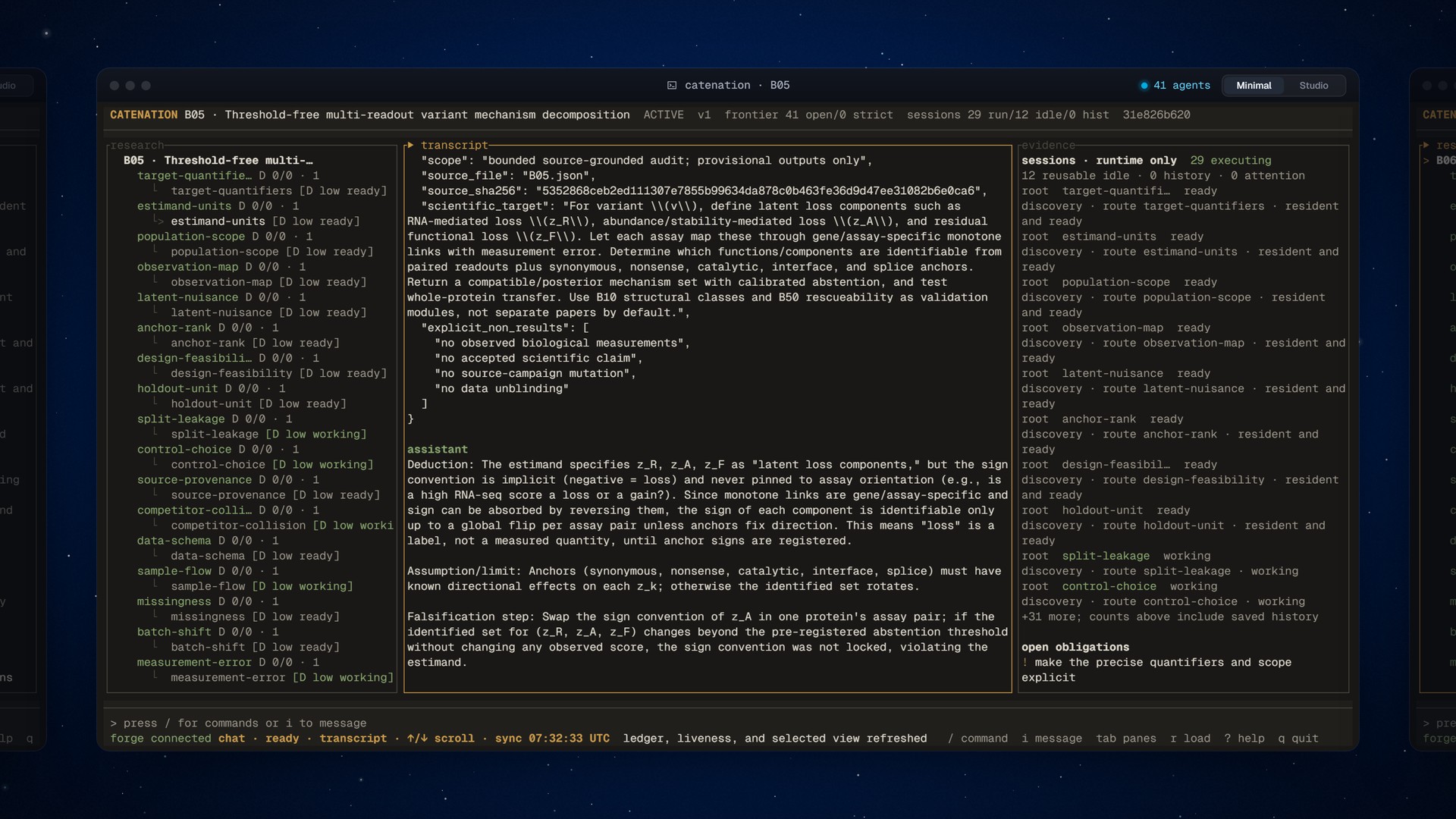
Every research question gets its own team of 37 to 44 AI agents. Catenation runs 30 computational-biology campaigns concurrently: 1,215 agents at once, and every agent saves its own source audit.

Browse all 30 campaigns
Film: campaign B05 working live in the native Catenation terminal, with 41 agents on one research question. The camera switches between campaigns B01 to B04 while every campaign keeps running, then tiles out to all 30 computational-biology campaigns and 1,215 AI agents at once. Built in Rust, the runtime uses 21 times less memory than Claude Code and 4.4 times less than Codex CLI with one active session, and about 22 and 2.5 times less with ten. Teammates join four live campaigns, the film visits the 49-agent Kunz mathematics campaign, and returns to the whole fleet.
  1. 0:00B05 live in the native terminal: 41 agents on one question.
  2. 0:05Switch campaigns. Every other campaign keeps running.
  3. 0:12Tile out: 30 campaigns and 1,215 agents, at once.
  4. 0:20Built in Rust: 21× less memory than Claude Code, 4.4× less than Codex CLI.
  5. 0:26Your whole team, across the fleet, while the agents keep working.
  6. 0:30Also mathematics: 49 agents on the Kunz campaign. Then back to all 30.
30

computational-biology campaigns, running at once

1,215

AI agents at once, 37–⁠44 on every campaign

993

agents running at capture

1,215

saved source audits, one from every agent

Every campaign runs on a local open-weight 27B model.

30 research questions

running at captureidle

Research record

Keep everything the paper leaves out.

AI now produces proofs faster than anyone can digest them. Catenation keeps the development behind every result: derivations, failed constructions, counterexamples, changed assumptions and verification evidence, linked so researchers see why it works and carry the method forward.

Put agents to work on a paper and the campaign builds itself: every step recorded, linked, and formalized as it goes.
  • Trace why it works

    Follow any step back through the derivations, computations and checks that produced it, with Lean formalization alongside. An AI proof no longer comes out of nowhere.

  • See where alternatives fail

    Every dead end keeps the counterexample or obstruction that stopped it, pinned to the exact step. Nobody spends Tuesday rediscovering Monday.

  • Carry methods across fields

    Step embeddings cluster ideas by structure and meaning, so a technique from one campaign surfaces wherever it applies, even in another field.

The transfer test

With the record, can a researcher solve a related problem, explain a necessary assumption, or repair a broken argument better than with the paper or transcript alone? That is the bar we build to.

Why now

Case study

Taking on the world’s hardest problems.

Nivat’s conjecture stood open for 29 years. Catenation’s research campaign proved it.

Independently verified by researchers in symbolic dynamics

First posed in 1997 Proved by Catenation in 2026

The question: does limited local pattern variety force a global period?

What Catenation did

From the campaign ledger

20 connected claims25 dependencies8 refuted, kept apart

The proof’s dependency graph from the campaign ledger: 20 connected claims and 25 dependencies lead to Nivat’s conjecture, proved and independently verified. Refuted shortcuts sit apart, with no connecting edges.

  1. 01Explore

    11approach families

    Run across 7 original agent histories.

  2. 02Refute

    8refuted shortcuts

    Kept on record as negative knowledge.

  3. 03Connect

    46claims in the ledger

    20 linked by 25 recorded dependencies.

  4. 04Verify

    2final reviews passed

    Then independently verified.

Research output

Research, written up.

Read the 15 manuscripts from the Mantis Discovery pilot, alongside papers by the founder and collaborators with their companion sites.

SpotlightAI & ML · agent memory

Beyond Retrieval: Selective Reconsolidation in Persistent Agent Memory

Sushaan Kandukoori, Pranava Kumar

Persistent agent memory can preserve conclusions after their evidence has been invalidated. Selective reconsolidation records AND/OR justification structure, withdraws unsupported consequences after review, and retains conclusions with independent justification.

Why it’s hereThe question behind Catenation’s evidence ledger: when evidence is withdrawn, which conclusions still stand?

Justification graph. Conclusion X requires sources a and b; conclusion Y needs source b or source c.
  1. Source b is withdrawn.
  2. X needed a and b, so it is retracted.
  3. Y still has c, so it stands.

Companion research5

Papers with the work behind them.

The founder’s mathematics work shaped Catenation’s focus on exact targets, failed approaches, reproducible calculations, and independent checking.

Research record

Manuscripts · 202615

The Mantis Discovery pilot manuscripts.

  • AI & ML

    Locality and global information in elliptic solvers

    Information & approximation

    13 pp.Open PDF: Locality and global information in elliptic solvers
  • Mathematics

    The inertia of matching cofactor matrices

    Graphs & spectral structure

    19 pp.Open PDF: The inertia of matching cofactor matrices
  • Mathematics

    A rounding morphism for additive structure: Sidon subsets and codes with separated pair-sums

    Additive combinatorics

    21 pp.Open PDF: A rounding morphism for additive structure: Sidon subsets and codes with separated pair-sums
  • AI & ML

    Regression Coresets: Attainable Fits, Conditioning, and Reuse

    Learning theory & optimization

    26 pp.Open PDF: Regression Coresets: Attainable Fits, Conditioning, and Reuse
  • Mathematics

    Repetition graphs and the growth of pattern-avoiding sequences

    Enumeration & asymptotics

    22 pp.Open PDF: Repetition graphs and the growth of pattern-avoiding sequences
  • Physics

    Boundary spectra and weak collisional relaxation in an electrostatic gyrokinetic model

    Kinetic theory & operators

    24 pp.Open PDF: Boundary spectra and weak collisional relaxation in an electrostatic gyrokinetic model

Manuscripts · 2026, from the Mantis Discovery pilot. More on the way.

Browse on Mantis Discovery

Team

The people.

Thirteen mathematicians, scientists, and engineers working on Catenation’s ecosystem. The team brings Olympiad problem-solving, scientific research, and engineering experience to the research workflow.

Pranava Kumar

Founder & CEO

Pranava builds Catenation’s research harnesses. His work spans agent orchestration, scientific computation, and AI-assisted research.

  • 2026 U.S. Physics TeamUSAPhO gold medalist
  • USACO Platinum15th in the U.S.
  • 300+ pull requestsAuthored across Mantis and MantisAPI
  • MIT Kellis LabAI-assisted research
  • Proved Nivat’s conjectureAuthor of A proof of Nivat’s conjecture
  • Leads Mantis DiscoveryCore architect of Mantis

Relentless about the problem. Exacting about the evidence.

Also Non-Trivial Fellow · NCSSM

Ecosystem team13

  • Jet Guan

    Trinity College, Cambridge

    Mathematics

    2025 International Mathematical Olympiad silver medalist for the UK. Selected for the UK teams at the Romanian Master of Mathematics and Balkan Mathematical Olympiad.

  • Shrey Sharma

    UC Berkeley · incoming

    EECS + mathematics

    Regents’ and Chancellor’s Scholar. USAMO qualifier and USAPhO honorable mention, with top-ten individual and team finishes at SMT and HMMT.

  • Mohammed Hosseini

    Harvard · incoming

    Mathematics

    German IMO selection-camp qualifier with research in enumerative combinatorics. Former high-frequency trading intern; ranked on the Jane Street puzzle leaderboard for 27 consecutive months.

  • Chris

    UC Berkeley

    Mathematics

    Mathematics sophomore planning a computer-science double major. AIME qualifier with research in random graphs and interests in algebra, number theory, and probability.

  • Will Kim

    Stanford · incoming

    Mathematics

    Three-time AIME qualifier with top placements at the Stanford and Berkeley Math Tournaments. Plans to study mathematics, with interests in number theory and combinatorics.

  • Roselle Ren

    Trinity College, Cambridge

    Theoretical physics + mathematics

    Research in string theory, three-dimensional N=4 supersymmetric gauge theories, and quantum gravity.

  • Devom Brahmbhatt

    Princeton · incoming

    Competitive programming + ML research

    Reached USACO Platinum. Former quantitative intern at Susquehanna International Group. Contributing researcher on the Compatibility Atlas for model-adapter merges.

  • Jachin Thilak

    Stanford, Berkeley, USC + UCSC research

    AI + machine learning

    Research spanning medical imaging and biosensors, including first-author UC Berkeley research on an ML biosensor for cardiovascular disease. Former Google intern.

  • Anthony Kiami

    Penn Engineering · incoming

    AI engineering + statistics

    Pursuing artificial intelligence engineering and statistics at Penn’s School of Engineering and Applied Science, with a concentration in machine learning.

  • Dev Dhooper

    Harvard · incoming

    Electrical engineering + computer science

    Research background in AI and robotics, including applications to ophthalmology. Interested in linear algebra and machine learning.

  • Renier Quintero

    Harvard · incoming

    Human biology + computational modeling

    University of Miami research assistant studying ABCA7 and Alzheimer’s disease. Experience in trauma-surgery research and computational modeling; pursuing a pre-med track.

  • Tina Gao

    MIT · incoming

    Mathematical competitions

    MATHCOUNTS National qualifier, two-time AIME qualifier, and AMC 8 Distinguished Honor Roll recipient.

  • Applied mathematics + computer science

    Studying applied mathematics and computer science at Princeton.

Explore the Mantis Discovery pilot

Company

Start with hard research.
Build the infrastructure.

We’re starting with computational research teams whose projects span many sessions, tools, and competing approaches. Mathematics is our proving ground, with computational biology extending the system into another scientific domain.

  1. Current

    Working research harness

    Recursive agents, a programmable context runtime, an evolving harness, scientific tools, and a target-bound evidence record.

    TodayMantis Forge pilot integration

  2. Design-partner phase

    Focused research pilots

    Work with a small number of teams on scoped projects and integrations. Measure useful results and the time experts spend checking them.

    Business model · nextScoped pilots and custom integrations

  3. Our direction

    Private research infrastructure

    Extend this foundation into a platform subscription plus compute, with domain-specific tools and review workflows inside a team’s own environment.

    Business model · directionPlatform subscription plus compute

Running a research project that takes more than a conversation?

The same architecture can support mathematical modeling, simulation, and domain-specific enterprise workflows.

Discuss a research pilot

Questions

Questions, answered.

Who Catenation is for, how it differs, how it will make money, and how a campaign runs.

The company

Who is it for?

Computational research teams running multi-day projects: work that spans many sessions, tools, and competing approaches. Mathematics is our proving ground, and computational biology extends the system into a second scientific domain.

How is this different from a frontier model’s own agents?

Frontier labs already offer managed long-horizon agents, skills, and persistent compute. Catenation gives frontier-model agents a persistent workspace for research that spans sessions, built around scientific project state: a fixed target, parallel routes, exact tools, a record of failed approaches, the dependencies between pieces of evidence, and review gates before a result counts. When a premise fails, the claims that rest on it are invalidated and the gap reopens.

How does Catenation relate to Mantis?

Catenation is an independent product. Mantis Forge is a focused pilot integration that connects Catenation to Mantis, a research workspace in the MIT CSAIL ecosystem, where Mantis Discovery researchers use it. Our founder, Pranava Kumar, also leads Mantis Discovery and is a core architect of Mantis. The pilot does not imply an institutional endorsement.

How will it make money?

First, scoped pilots and custom integrations with a small number of research teams, measured by useful results and the time experts spend checking them. Then a private platform subscription plus compute, with domain-specific tools and review workflows inside a team’s own environment. Mantis Forge, our pilot integration, is already in use today.

What’s behind the numbers?

Two benchmarks measured against published scores, a proved conjecture, and recorded runs of real sessions.

  • Measured

    Terminal-Bench Science 0.1. GPT-6 Astra + Catenation reaches a 72.8% task-resolution rate, 8.2 percentage points above GPT-6 Astra’s published 64.6%. Published scores for Claude Fable 5.1 (52.6%) and Claude Opus 5 (30.0%) complete the comparison.

  • Measured

    ProteinGym. Our ensemble was selected on 125 development proteins and compared with the reproduced Aster formula on 61 held-out proteins: a +0.02519 held-out gain in mean Spearman (95% protein-bootstrap interval +0.01128 to +0.03770). An independent evaluator replay, a separate implementation, passed.

  • Proved

    Nivat’s conjecture. Catenation’s research campaign proved the 1997 conjecture, open for 29 years. The proof is independently verified by researchers in symbolic dynamics, and the full proof is machine-checked in Lean 4 .

  • Recorded

    Recorded runs. Captures of actual Catenation sessions in mathematics and computational biology.

Sources, methods, and records

The product

Can it take research from scouting to a manuscript?

Start with a research area or a hard question. The scouting pipeline builds research corpora, maps prior work, ranks candidate problems, and develops falsifiable research briefs. Campaigns then explore approaches, run scientific tools, retain evidence, and assemble arguments, code, and manuscripts. You can also bring an existing problem and start there.

What does the harness add to a frontier model?

A research process that can keep going. Catenation turns model calls into persistent programs, recursive teams, and long-horizon campaigns. Agents can delegate, exchange findings, use scientific tools, and refine the harness from their own trajectories. It is built for sustained work across hours and days, with durable state between runs.

How does the harness evolve?

Prompts, skills, memory, and sub-agent specifications are editable state. The runtime can review a trajectory and create, update, or remove these resources, then apply scoped revisions at turn boundaries. Checksums, revision history, and rollback make those changes inspectable.

Can I inspect how a result was reached?

Yes. The research record links claims, dependencies, source material, tool calls, calculations, and reviews. Failed approaches remain visible too. The result is something people can understand and build on: a useful argument, a reusable technique, or an insight into why a seemingly promising route fails.

How is the research record different from a transcript or a paper?

A transcript is a raw log, and a paper keeps only the final argument. The record keeps what happens in between, typed and linked: intermediate derivations, failed constructions and the counterexamples that stopped them, changes in assumptions, and verification evidence such as exact replays, reviews, and Lean checks. Researchers can trace why a method works, see exactly where an alternative fails, and carry a technique to the next problem. Our test is transfer: someone with the record should solve a related problem or repair a broken argument better than someone with only the paper.

Which models and compute can I use?

The runtime supports Codex authentication, API-key providers, and configured compatible endpoints for local or hosted models. Persistent Python, Wolfram, and cluster workflows connect agents to scientific compute, including NCShare and MIT ORCD. Model access, tools, and deployment are configured for each environment.

Contact

Give us your hardest problems.

Bring the question, the constraints, and the result worth working for.